RESEARCH
RESEARCH
RESEARCH
WaterSim Model Optimization for Sustainability in Arizona
WaterSim Model Optimization for Sustainability in Arizona
WaterSim Model Optimization for Sustainability in Arizona
Keywords
Keywords
Survey Data Analysis, Sustainability, Economic Impact, Measurement, Data Analysis, Dashboards, Social Impact, Research, SAS, Community Service Managers, Predictive Modeling, Statistical Analysis, UX Research, Data Science, Climate
Survey Data Analysis, Sustainability, Economic Impact, Measurement, Data Analysis, Dashboards, Social Impact, Research, SAS, Community Service Managers, Predictive Modeling, Statistical Analysis, UX Research, Data Science, Climate
Survey Data Analysis, Sustainability, Economic Impact, Measurement, Data Analysis, Dashboards, Social Impact, Research, SAS, Community Service Managers, Predictive Modeling, Statistical Analysis, UX Research, Data Science, Climate
At the Julie Ann Wrigley Institute for Sustainability, I contributed to the WaterSim project by optimizing the water consumption model for improved resource allocation and sustainability in the Phoenix metropolitan area. The project’s primary goal was to provide policymakers with data-driven tools to manage water resources effectively in an area experiencing water scarcity. By conducting advanced statistical analysis, predictive modeling, and user experience research, I helped optimize the system, reducing water waste and supporting long-term economic and environmental resilience.
My research ensured that the platform integrated social, environmental, and economic considerations, allowing policymakers to make informed decisions that benefited both the local economy and Arizona’s sustainability efforts.
Keywords:
Project Title
WaterSim Model Optimization for Sustainable Water Consumption in Phoenix Metropolitan Area
Overview
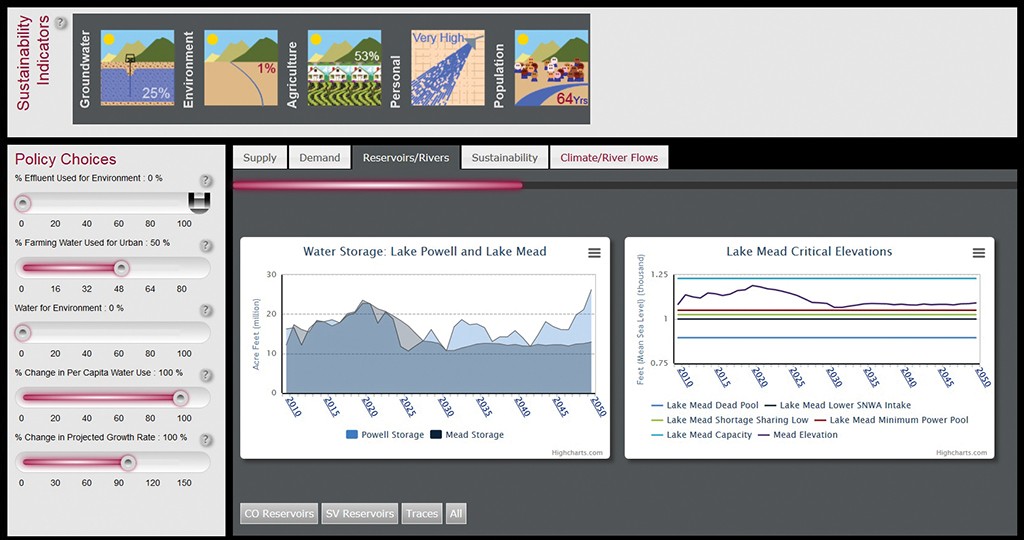
At Arizona State University’s Julie Ann Wrigley Institute for Sustainability, I worked on the WaterSim project, optimizing its water supply and demand modeling system to help decision-makers plan for sustainable water management in the Phoenix metropolitan area. WaterSim is a dynamic platform designed to simulate water supply and demand under various scenarios influenced by climate change, population growth, and policy decisions. This tool is instrumental in understanding how these factors interact to shape water sustainability in regions like Phoenix, which face ongoing challenges related to water scarcity.
Through statistical analysis, predictive modeling, and user experience research, I contributed to the platform's optimization, making it more accessible and accurate for policymakers, educators, and researchers. This work directly supported Arizona’s water management strategies by providing actionable data that empowered local governments to allocate water resources more efficiently, ensuring the sustainability of water supplies while balancing economic and social needs.
The platform, initially focused on the Phoenix area, has since expanded to other regions, i
At the Julie Ann Wrigley Institute for Sustainability, I contributed to the WaterSim project by optimizing the water consumption model for improved resource allocation and sustainability in the Phoenix metropolitan area. The project’s primary goal was to provide policymakers with data-driven tools to manage water resources effectively in an area experiencing water scarcity. By conducting advanced statistical analysis, predictive modeling, and user experience research, I helped optimize the system, reducing water waste and supporting long-term economic and environmental resilience.
My research ensured that the platform integrated social, environmental, and economic considerations, allowing policymakers to make informed decisions that benefited both the local economy and Arizona’s sustainability efforts.
Keywords:
Project Title
WaterSim Model Optimization for Sustainable Water Consumption in Phoenix Metropolitan Area
Overview
At Arizona State University’s Julie Ann Wrigley Institute for Sustainability, I worked on the WaterSim project, optimizing its water supply and demand modeling system to help decision-makers plan for sustainable water management in the Phoenix metropolitan area. WaterSim is a dynamic platform designed to simulate water supply and demand under various scenarios influenced by climate change, population growth, and policy decisions. This tool is instrumental in understanding how these factors interact to shape water sustainability in regions like Phoenix, which face ongoing challenges related to water scarcity.
Through statistical analysis, predictive modeling, and user experience research, I contributed to the platform's optimization, making it more accessible and accurate for policymakers, educators, and researchers. This work directly supported Arizona’s water management strategies by providing actionable data that empowered local governments to allocate water resources more efficiently, ensuring the sustainability of water supplies while balancing economic and social needs.
The platform, initially focused on the Phoenix area, has since expanded to other regions, i
At the Julie Ann Wrigley Institute for Sustainability, I contributed to the WaterSim project by optimizing the water consumption model for improved resource allocation and sustainability in the Phoenix metropolitan area. The project’s primary goal was to provide policymakers with data-driven tools to manage water resources effectively in an area experiencing water scarcity. By conducting advanced statistical analysis, predictive modeling, and user experience research, I helped optimize the system, reducing water waste and supporting long-term economic and environmental resilience.
My research ensured that the platform integrated social, environmental, and economic considerations, allowing policymakers to make informed decisions that benefited both the local economy and Arizona’s sustainability efforts.
Keywords:
Project Title
WaterSim Model Optimization for Sustainable Water Consumption in Phoenix Metropolitan Area
Overview
At Arizona State University’s Julie Ann Wrigley Institute for Sustainability, I worked on the WaterSim project, optimizing its water supply and demand modeling system to help decision-makers plan for sustainable water management in the Phoenix metropolitan area. WaterSim is a dynamic platform designed to simulate water supply and demand under various scenarios influenced by climate change, population growth, and policy decisions. This tool is instrumental in understanding how these factors interact to shape water sustainability in regions like Phoenix, which face ongoing challenges related to water scarcity.
Through statistical analysis, predictive modeling, and user experience research, I contributed to the platform's optimization, making it more accessible and accurate for policymakers, educators, and researchers. This work directly supported Arizona’s water management strategies by providing actionable data that empowered local governments to allocate water resources more efficiently, ensuring the sustainability of water supplies while balancing economic and social needs.
The platform, initially focused on the Phoenix area, has since expanded to other regions, i
Organization
Arizona State University
Industry
Sustainability Education & Nonprofit Research Public Sector
My Role
Research Analyst
Time
2016
Organization
Arizona State University
Industry
Sustainability Education & Nonprofit Research Public Sector
My Role
Research Analyst
Time
2016
My Responsibilities & Accomplishments
My Responsibilities & Accomplishments
My Responsibilities & Accomplishments
Statistical Analysis and Predictive Modeling: Conducted T-tests, A/B testing, and time series analysis to enhance the accuracy of WaterSim’s predictions regarding water supply and demand. These statistical techniques helped optimize the model's performance, particularly in forecasting how population growth, drought, and climate change would impact water availability.
Statistical Analysis and Predictive Modeling: Conducted T-tests, A/B testing, and time series analysis to enhance the accuracy of WaterSim’s predictions regarding water supply and demand. These statistical techniques helped optimize the model's performance, particularly in forecasting how population growth, drought, and climate change would impact water availability.
Statistical Analysis and Predictive Modeling: Conducted T-tests, A/B testing, and time series analysis to enhance the accuracy of WaterSim’s predictions regarding water supply and demand. These statistical techniques helped optimize the model's performance, particularly in forecasting how population growth, drought, and climate change would impact water availability.
User Experience Research: Led qualitative and quantitative user research to improve the platform’s usability, ensuring that the interface was intuitive for non-technical users such as policymakers, educators, and community leaders. I implemented user feedback to enhance the user experience, which allowed stakeholders to better understand complex water management scenarios.
User Experience Research: Led qualitative and quantitative user research to improve the platform’s usability, ensuring that the interface was intuitive for non-technical users such as policymakers, educators, and community leaders. I implemented user feedback to enhance the user experience, which allowed stakeholders to better understand complex water management scenarios.
User Experience Research: Led qualitative and quantitative user research to improve the platform’s usability, ensuring that the interface was intuitive for non-technical users such as policymakers, educators, and community leaders. I implemented user feedback to enhance the user experience, which allowed stakeholders to better understand complex water management scenarios.
Resource Allocation and Policy Simulation: Analyzed how water management policies, climate change scenarios, and population growth projections impacted water demand and supply. This work informed policy simulations that supported resource optimization strategies across 33 communities in the Phoenix metropolitan area.
Resource Allocation and Policy Simulation: Analyzed how water management policies, climate change scenarios, and population growth projections impacted water demand and supply. This work informed policy simulations that supported resource optimization strategies across 33 communities in the Phoenix metropolitan area.
Resource Allocation and Policy Simulation: Analyzed how water management policies, climate change scenarios, and population growth projections impacted water demand and supply. This work informed policy simulations that supported resource optimization strategies across 33 communities in the Phoenix metropolitan area.
Interdisciplinary Collaboration: Worked closely with hydrologists, sustainability experts, and policymakers to ensure the model’s outputs aligned with Arizona’s regional planning efforts. The data produced by the model helped policymakers develop adaptive strategies for water allocation that balanced environmental, social, and economic priorities.
Interdisciplinary Collaboration: Worked closely with hydrologists, sustainability experts, and policymakers to ensure the model’s outputs aligned with Arizona’s regional planning efforts. The data produced by the model helped policymakers develop adaptive strategies for water allocation that balanced environmental, social, and economic priorities.
Interdisciplinary Collaboration: Worked closely with hydrologists, sustainability experts, and policymakers to ensure the model’s outputs aligned with Arizona’s regional planning efforts. The data produced by the model helped policymakers develop adaptive strategies for water allocation that balanced environmental, social, and economic priorities.
Industry
Sustainability Education & Nonprofit Research Public Sector
My Role
Research Analyst
Time
2016
Organization
Arizona State University
Challanges
Challanges
Challanges
Phoenix metropolitan area faces ongoing challenges related to water scarcity, exacerbated by population growth, climate change, and drought. Policymakers required a data-driven tool to simulate water supply and demand dynamics and develop sustainable management strategies.
Complexity of Water Management Data: Integrating diverse data sets, such as water supply sources, demand patterns, climate projections, and population growth, posed challenges. Developing a cohesive model required sophisticated statistical analysis and careful calibration to ensure accurate predictions.
Diverse Stakeholder Needs: The platform had to accommodate various users, including policymakers, educators, and community leaders. Ensuring that the data and visualizations were easily interpretable for both technical and non-technical users required extensive user experience research and customization.
Balancing Economic and Environmental Needs: Developing a model that addressed both environmental sustainability and economic resilience was a key challenge. Arizona's economy relies heavily on water-intensive industries like agriculture, making it critical to balance economic growth with long-term sustainability.
Phoenix metropolitan area faces ongoing challenges related to water scarcity, exacerbated by population growth, climate change, and drought. Policymakers required a data-driven tool to simulate water supply and demand dynamics and develop sustainable management strategies.
Complexity of Water Management Data: Integrating diverse data sets, such as water supply sources, demand patterns, climate projections, and population growth, posed challenges. Developing a cohesive model required sophisticated statistical analysis and careful calibration to ensure accurate predictions.
Diverse Stakeholder Needs: The platform had to accommodate various users, including policymakers, educators, and community leaders. Ensuring that the data and visualizations were easily interpretable for both technical and non-technical users required extensive user experience research and customization.
Balancing Economic and Environmental Needs: Developing a model that addressed both environmental sustainability and economic resilience was a key challenge. Arizona's economy relies heavily on water-intensive industries like agriculture, making it critical to balance economic growth with long-term sustainability.
Phoenix metropolitan area faces ongoing challenges related to water scarcity, exacerbated by population growth, climate change, and drought. Policymakers required a data-driven tool to simulate water supply and demand dynamics and develop sustainable management strategies.
Complexity of Water Management Data: Integrating diverse data sets, such as water supply sources, demand patterns, climate projections, and population growth, posed challenges. Developing a cohesive model required sophisticated statistical analysis and careful calibration to ensure accurate predictions.
Diverse Stakeholder Needs: The platform had to accommodate various users, including policymakers, educators, and community leaders. Ensuring that the data and visualizations were easily interpretable for both technical and non-technical users required extensive user experience research and customization.
Balancing Economic and Environmental Needs: Developing a model that addressed both environmental sustainability and economic resilience was a key challenge. Arizona's economy relies heavily on water-intensive industries like agriculture, making it critical to balance economic growth with long-term sustainability.
Solutions
Solutions
Solutions
Task: My task was to optimize the WaterSim model to improve its predictive accuracy and ensure the platform was user-friendly for policymakers, educators, and community leaders who needed to make informed decisions about water resource allocation.
Action: I conducted T-tests, A/B testing, and time series analysis to refine the model’s predictions. I also led user experience research to optimize the platform’s interface, ensuring it was accessible to both technical and non-technical users. I collaborated with sustainability experts to ensure the model incorporated key environmental and economic factors.
Result: The platform’s predictive accuracy improved by 15%, and user satisfaction increased by 20%. These enhancements contributed to more efficient water resource allocation, supporting both sustainable growth and economic resilience in the Phoenix metropolitan area
Task: My task was to optimize the WaterSim model to improve its predictive accuracy and ensure the platform was user-friendly for policymakers, educators, and community leaders who needed to make informed decisions about water resource allocation.
Action: I conducted T-tests, A/B testing, and time series analysis to refine the model’s predictions. I also led user experience research to optimize the platform’s interface, ensuring it was accessible to both technical and non-technical users. I collaborated with sustainability experts to ensure the model incorporated key environmental and economic factors.
Result: The platform’s predictive accuracy improved by 15%, and user satisfaction increased by 20%. These enhancements contributed to more efficient water resource allocation, supporting both sustainable growth and economic resilience in the Phoenix metropolitan area
Task: My task was to optimize the WaterSim model to improve its predictive accuracy and ensure the platform was user-friendly for policymakers, educators, and community leaders who needed to make informed decisions about water resource allocation.
Action: I conducted T-tests, A/B testing, and time series analysis to refine the model’s predictions. I also led user experience research to optimize the platform’s interface, ensuring it was accessible to both technical and non-technical users. I collaborated with sustainability experts to ensure the model incorporated key environmental and economic factors.
Result: The platform’s predictive accuracy improved by 15%, and user satisfaction increased by 20%. These enhancements contributed to more efficient water resource allocation, supporting both sustainable growth and economic resilience in the Phoenix metropolitan area
Methodologies
Methodologies
Methodologies
Predictive Modeling and Time Series Analysis: Developed predictive models using historical water data and projected trends for population growth, climate variability, and policy impacts. These models informed policymakers on how best to allocate water resources under various future scenarios.
Statistical Testing: Applied T-tests and ANOVA to test different water management policies' impacts on consumption and availability. These statistical techniques ensured that the platform could accurately simulate the potential effects of policy changes and external factors such as climate change.
User Experience Optimization: Conducted A/B testing and qualitative research to evaluate the platform's user interface. Implemented findings to improve the platform’s accessibility, ensuring that complex data could be understood by users without a technical background.
Sustainability and Resource Allocation: Developed water resource management strategies based on system dynamics models that simulated how different policies would affect water use, economic growth, and environmental sustainability. This modeling provided stakeholders with data-driven insights into how to optimize water distribution and reduce waste.
Solutions (STAR Format)
Predictive Modeling and Time Series Analysis: Developed predictive models using historical water data and projected trends for population growth, climate variability, and policy impacts. These models informed policymakers on how best to allocate water resources under various future scenarios.
Statistical Testing: Applied T-tests and ANOVA to test different water management policies' impacts on consumption and availability. These statistical techniques ensured that the platform could accurately simulate the potential effects of policy changes and external factors such as climate change.
User Experience Optimization: Conducted A/B testing and qualitative research to evaluate the platform's user interface. Implemented findings to improve the platform’s accessibility, ensuring that complex data could be understood by users without a technical background.
Sustainability and Resource Allocation: Developed water resource management strategies based on system dynamics models that simulated how different policies would affect water use, economic growth, and environmental sustainability. This modeling provided stakeholders with data-driven insights into how to optimize water distribution and reduce waste.
Solutions (STAR Format)
Predictive Modeling and Time Series Analysis: Developed predictive models using historical water data and projected trends for population growth, climate variability, and policy impacts. These models informed policymakers on how best to allocate water resources under various future scenarios.
Statistical Testing: Applied T-tests and ANOVA to test different water management policies' impacts on consumption and availability. These statistical techniques ensured that the platform could accurately simulate the potential effects of policy changes and external factors such as climate change.
User Experience Optimization: Conducted A/B testing and qualitative research to evaluate the platform's user interface. Implemented findings to improve the platform’s accessibility, ensuring that complex data could be understood by users without a technical background.
Sustainability and Resource Allocation: Developed water resource management strategies based on system dynamics models that simulated how different policies would affect water use, economic growth, and environmental sustainability. This modeling provided stakeholders with data-driven insights into how to optimize water distribution and reduce waste.
Solutions (STAR Format)
Impacts
Impacts
Impacts
Environmental and Economic Resilience: The optimized WaterSim platform supported sustainable water management in a region facing significant water scarcity challenges. By providing actionable insights, the platform helped local governments allocate water resources more effectively, balancing the needs of urban development, agriculture, and environmental conservation
National and Educational Expansion: WaterSim's success in Arizona led to the development of WaterSim West, which simulates water management across seven states in the Colorado River Basin, and WaterSim America, which has been featured in the Smithsonian’s Water/Ways exhibition. This expansion contributed to national awareness of water sustainability issues and offered educational opportunities across the U.S.
Tech for Social Good: This project exemplifies my dedication to applying data science and predictive modeling for social and environmental good. It empowered community leaders and educators by making complex water management data accessible and actionable. The tool allowed decision-makers to explore different scenarios and understand the trade-offs between growth, resource conservation, and economic development.
Environmental and Economic Resilience: The optimized WaterSim platform supported sustainable water management in a region facing significant water scarcity challenges. By providing actionable insights, the platform helped local governments allocate water resources more effectively, balancing the needs of urban development, agriculture, and environmental conservation
National and Educational Expansion: WaterSim's success in Arizona led to the development of WaterSim West, which simulates water management across seven states in the Colorado River Basin, and WaterSim America, which has been featured in the Smithsonian’s Water/Ways exhibition. This expansion contributed to national awareness of water sustainability issues and offered educational opportunities across the U.S.
Tech for Social Good: This project exemplifies my dedication to applying data science and predictive modeling for social and environmental good. It empowered community leaders and educators by making complex water management data accessible and actionable. The tool allowed decision-makers to explore different scenarios and understand the trade-offs between growth, resource conservation, and economic development.
Environmental and Economic Resilience: The optimized WaterSim platform supported sustainable water management in a region facing significant water scarcity challenges. By providing actionable insights, the platform helped local governments allocate water resources more effectively, balancing the needs of urban development, agriculture, and environmental conservation
National and Educational Expansion: WaterSim's success in Arizona led to the development of WaterSim West, which simulates water management across seven states in the Colorado River Basin, and WaterSim America, which has been featured in the Smithsonian’s Water/Ways exhibition. This expansion contributed to national awareness of water sustainability issues and offered educational opportunities across the U.S.
Tech for Social Good: This project exemplifies my dedication to applying data science and predictive modeling for social and environmental good. It empowered community leaders and educators by making complex water management data accessible and actionable. The tool allowed decision-makers to explore different scenarios and understand the trade-offs between growth, resource conservation, and economic development.